Baler
Packs dry hay or straw into bales for storage and feeding.
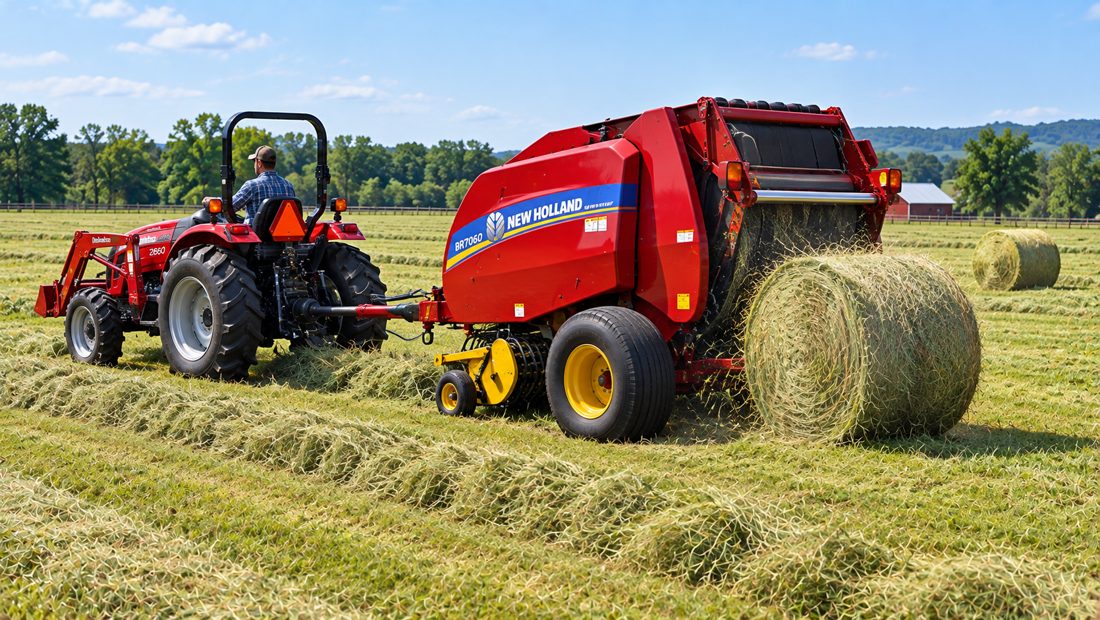
Why choose a baler
A baler picks up the windrow and packs it into square bales (handled by hand) or round bales (handled with a tractor). Square bales fit small farms and horse owners; round bales store and feed more hay with less labor.
Small plot: stack loose hay or hire a custom baler.
What it is used for
- Baling hay for livestock
- Baling straw after the grain harvest
- Baling for sale
How to use it
- Bale when the hay is dry enough: about 15 to 18 percent for square bales, check with a hay meter.
- Drive at a steady speed along the windrow.
- Check bale tightness and twine tying often.
- Store bales off the ground and under cover.
- Stop the PTO and engine before clearing a plug; never feed hay in by hand.
- Wet hay can heat and catch fire in the barn; check moisture.
- Watch the knotter area and pickup.
Maintenance: keep it working
- Grease and oil daily; adjust the knotters.
- Replace worn pickup teeth and belts.
What to look for when you buy
- Small square baler for 50 hp; round baler 4x5 or 5x6 for 60 hp and up
- Twine or net wrap
- Parts and a dealer nearby
Where to buy it and what it costs
Typical price: $5,000 to $45,000. Three good choices:
Used small square baler (New Holland, John Deere)
about $5,000 to $12,000
Small-farm classic.
Used round baler 4x5 or 5x6
about $10,000 to $25,000
One person can do it all.
New round baler
about $35,000 to $45,000
Net wrap, monitor.
For tractors and field equipment, also check local dealers, farm auctions, Craigslist and Facebook Marketplace, and sites like TractorHouse and Machinery Pete. Have a mechanic look at used equipment before you buy.
Shop for any baler
Prices are typical U.S. store prices checked November 17, 2026. They change often with sales; check the store. Tools Critical is not paid by any store or brand.