Grain drill
Plants wheat, oats, soybeans, hay and pasture seed in narrow rows.
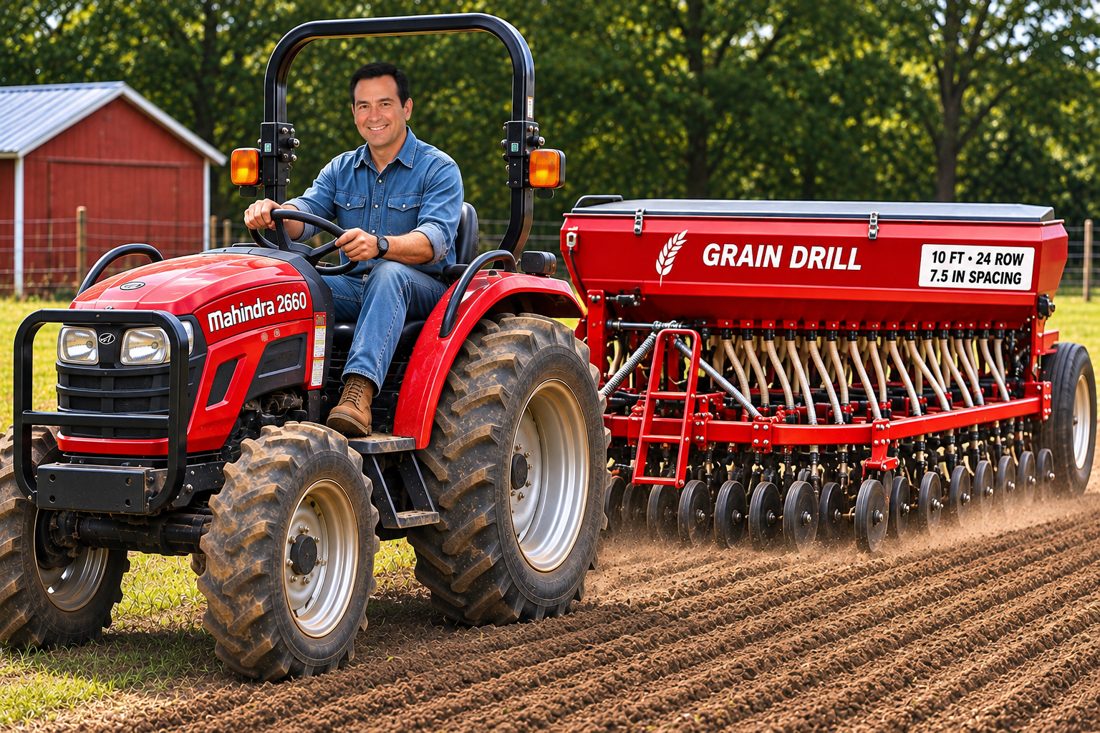
Why choose a grain drill
A grain drill plants small grains and grass seed in many narrow rows (6 to 10 inches apart) at an even depth. It plants wheat, oats, rye, soybeans, alfalfa, pasture and cover crops. A no-till drill plants straight into sod or residue without plowing.
Small plot: a hand broadcast spreader and a rake.
What it is used for
- Planting wheat, oats, barley and rye
- Planting soybeans in narrow rows
- Seeding alfalfa, hay and pasture
- Planting cover crops and food plots
How to use it
- Calibrate: turn the wheel a set number of times and weigh the seed; set to pounds per acre.
- Set the depth (wheat about 1 to 1.5 inches; grass and clover 1/4 inch).
- Drive at a steady speed; overlap a little.
- Check depth behind the drill in the first pass.
- Stop and lower it before reaching into the box.
- Wear gloves with treated seed.
Maintenance: keep it working
- Empty and clean the seed box; grease bearings.
- Replace worn disc openers.
What to look for when you buy
- 6 to 10 ft for a 50 to 75 hp tractor
- A small-seed (grass) box for hay and pasture
- No-till coulters if you plant without plowing
Where to buy it and what it costs
Typical price: $2,000 to $15,000. Three good choices:
Used conventional grain drill, 8 to 10 ft
about $2,000 to $5,000
Check the openers and meters.
New 3-point drill (Land Pride, Kasco, Great Plains)
about $6,000 to $10,000
For small farms.
No-till drill (or rent one from your conservation district)
about $10,000 to $15,000
Plant without plowing; many districts rent them.
For tractors and field equipment, also check local dealers, farm auctions, Craigslist and Facebook Marketplace, and sites like TractorHouse and Machinery Pete. Have a mechanic look at used equipment before you buy.
Shop for any grain drill
Prices are typical U.S. store prices checked November 17, 2026. They change often with sales; check the store. Tools Critical is not paid by any store or brand.